

Applied Mathematics (B.S.)
Prepare to excel in high-demand fields such as AI, machine learning, computational science, and more with our bachelor’s degree in applied mathematics.
Become a Practical Problem Solver in Illinois Tech’s B.S. in Applied Mathematics
Designed for students who are interested in combining applied mathematics with computer science and artificial intelligence to build skills that translate across tech-driven industries, Illinois Tech’s Bachelor of Science in Applied Mathematics combines modern computational and data-centric skills with a strong quantitative foundation. You will learn to tackle problems that range from multicriteria decision-making and financial modeling, to uncertainty quantification. Our curriculum emphasizes real-world problem solving and contemporary, in-demand quantitative skills, ensuring that you will be well prepared to transition to a career or advanced studies in mathematics, statistics, data science, or finance.
Program Overview
The B.S. in Applied Mathematics is a four-year program designed around helping you develop the skills so you can apply mathematics to real-world problems in science engineering, business, and society. As part of the program, you are required to complete a minor in a complementary area that deepens your expertise and enhances your job readiness.
You also have the flexibility to tailor your degree through five distinct specializations:
- Computational Math
- Mathematical Finance
- Stochastics
- Discrete Applied Math
- Applied Analysis
Career Opportunities
Graduates of our bachelor’s program in applied mathematics are well prepared for roles such as:
- Quantitative Analyst
- Data Scientist
- Operations Research Analyst
Here are a few courses our students find interesting:
MATH 380 Introduction to Mathematical Modeling This course embodies the applied essence of the applied mathematics major: turning real-world problems into mathematical language and solutions. Through case studies and projects, you will learn how to construct, analyze, and refine models that describe natural phenomena, engineering systems, economic behavior, and more. Rather than focusing solely on theory, MATH 380 emphasizes creative problem formulation and iterative model testing, skills that are indispensable for careers in science, finance, healthcare, and technology.
MATH 350 Introduction to Computational Mathematics Computational methods are central to modern applied mathematics, and MATH 350 provides you with a deep dive into numerical algorithms, approximation techniques, and computation-based problem solving. This course teaches you how to handle problems that cannot be solved exactly with analytical formulas, for example, approximating solutions to differential equations or large systems of equations. It also helps build essential computing skills used in simulations, scientific computing, data analysis, and engineering.
MATH 252 Introduction to Differential Equations Differential equations are the mathematical backbone of any discipline that involves change over time, from physics and engineering to biology and economics. MATH 252 will introduce you to both the theory and applications of ordinary differential equations, including systems that model interacting components in dynamic environments. This grounding is essential for understanding how mathematical descriptions translate into real systems, whether predicting population growth, modeling circuits, or simulating mechanical motion.
Admission to all undergraduate programs at Illinois Tech is evaluated via a holistic approach that takes various factors under consideration, including your high school performance and essays. Your choice of major will impact this process as well, because each major has its own criteria for admission.
To learn more about our admission selection process, recommended high school coursework, and our admitted student profile, please visit our admission website.
Tuition and Fees
Learn more about the university’s general tuition and fees, visit the Student Accounting website.
To get a more in-depth idea of the tuition and fees for the B.S. in Applied Mathematics, you can utilize the net price calculator tool.
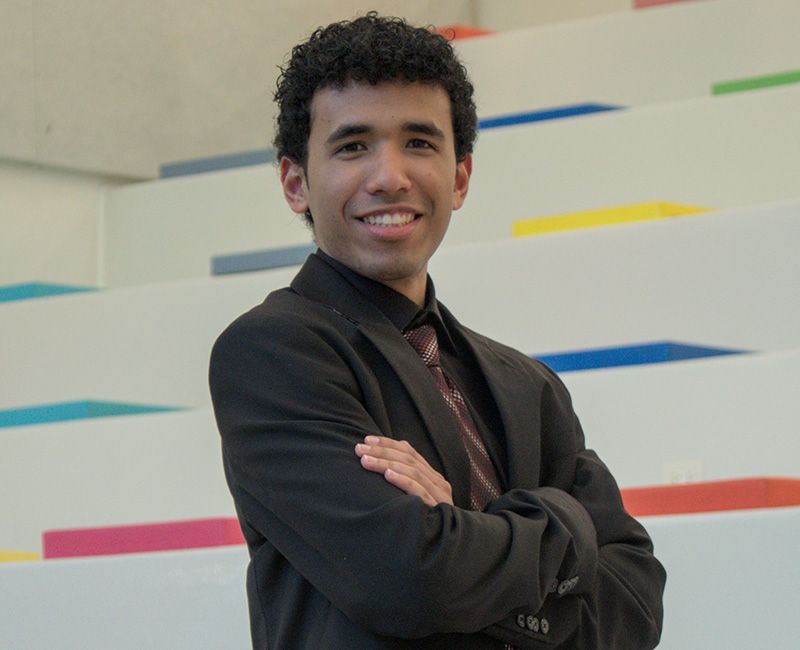
Leonardo M. Says...
“I want to help others in any way I can, guiding them through everything that mathematics and problem-solving has to offer to their lives.”
Leonardo Marciaga (MATH 2nd Year)

By working hard, getting to know fellow students, and reaching out to faculty, Aleksei Sorokin found it easy to work collaboratively on research at Illinois Tech.
Aleksei Sorokin (Applied Mathematics/Computer Science/M.A.S. Data Science 4th Year)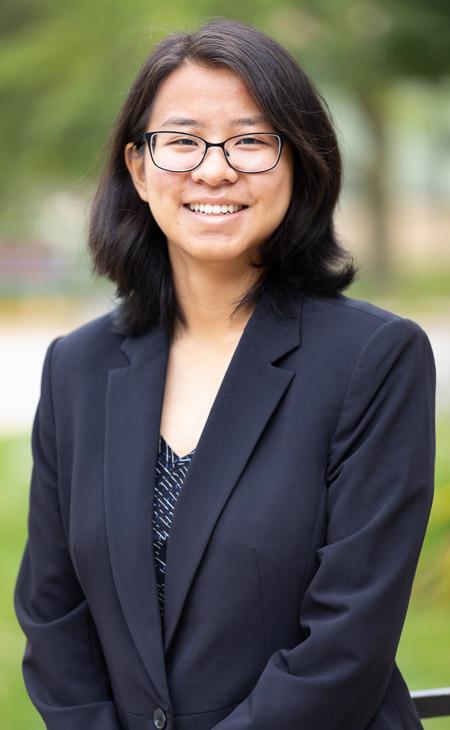
A summer abroad in Scotland allowed Victoria Belotti to learn more about Scottish history, culture, and politics through visiting the places and cities where these events occurred.
Victoria Belotti (Applied Mathematics/Statistics/M.S. CDSOR 2nd Year)
A passion for mathematics lead Czopek to Illinois Tech. An eagerness to share knowledge lead to a career.
Joanna Czopek (AMAT ’19)Program Specializations
- Computational Math
- Mathematical Finance
- Stochastics
- Discrete Applied Math
- Applied Analysis
Frequently Asked Questions (FAQs)
How much programming will I actually do, and in which languages?
Applied Mathematics majors at Illinois Tech complete at least one computer science sequence as part of their degree, typically starting with foundational programming courses such as CS 115/CS 116 or CS 105/CS 201, which cover object-oriented programming and core programming concepts like algorithms and data structures.
Although the curriculum itself focuses on mathematical modeling, computation, and analysis, programming is used regularly in courses such as Computational Mathematics and modeling courses to implement algorithms, analyze data, and create simulations. Popular languages in these contexts include Python and MATLAB (commonly used for computation and modeling in applied math), and basics of C++/Java are introduced in the required CS coursework.
Is there support if I’m coming in with limited programming experience?
Yes. The required computer science sequence in the B.S. in Applied Mathematics starts with introductory courses designed for students with little or no prior coding background. These courses teach programming fundamentals and build confidence in problem-solving with code.
Additionally, students have access to tutoring, study-groups, faculty office hours, and student organizations such as the Association for Computing Machinery, that can provide peer support and extra practice beyond the classroom.
Is this program more technical or more business/IT-focused?
The B.S. in Applied Mathematics is fundamentally technical and analytical, centered on mathematics, modeling, computation, and quantitative reasoning. Students learn to solve real-world problems using rigorous mathematical methods, algorithms, and analysis.
That said, the program includes flexibility—students must complete a minor in a related area (e.g., business, computer science) which enables them to tailor their experience toward more information technology-oriented, business analytics, or finance applications if desired.
Are there student organizations or clubs related to IT, cybersecurity, or systems?
Yes, here are a few student organizations related to IT and cybersecurity:
- CyberHawk Security, focused on cybersecurity interests.
- Association for Computing Machinery (ACM) and ACM-Women, which support programming and tech engagement.
- Machine Learning @ IIT, for students interested in AI and data modeling.
- Society for Industrial and Applied Mathematics (SIAM) Student Chapter offers talks, workshops, and networking in applied math and computation.
Get In Touch
For more information about the B.S. in Applied Mathematics, please contact Associate Teaching Professor Kiah Wah Ong at kong2@illinoistech.edu.